
 By Admin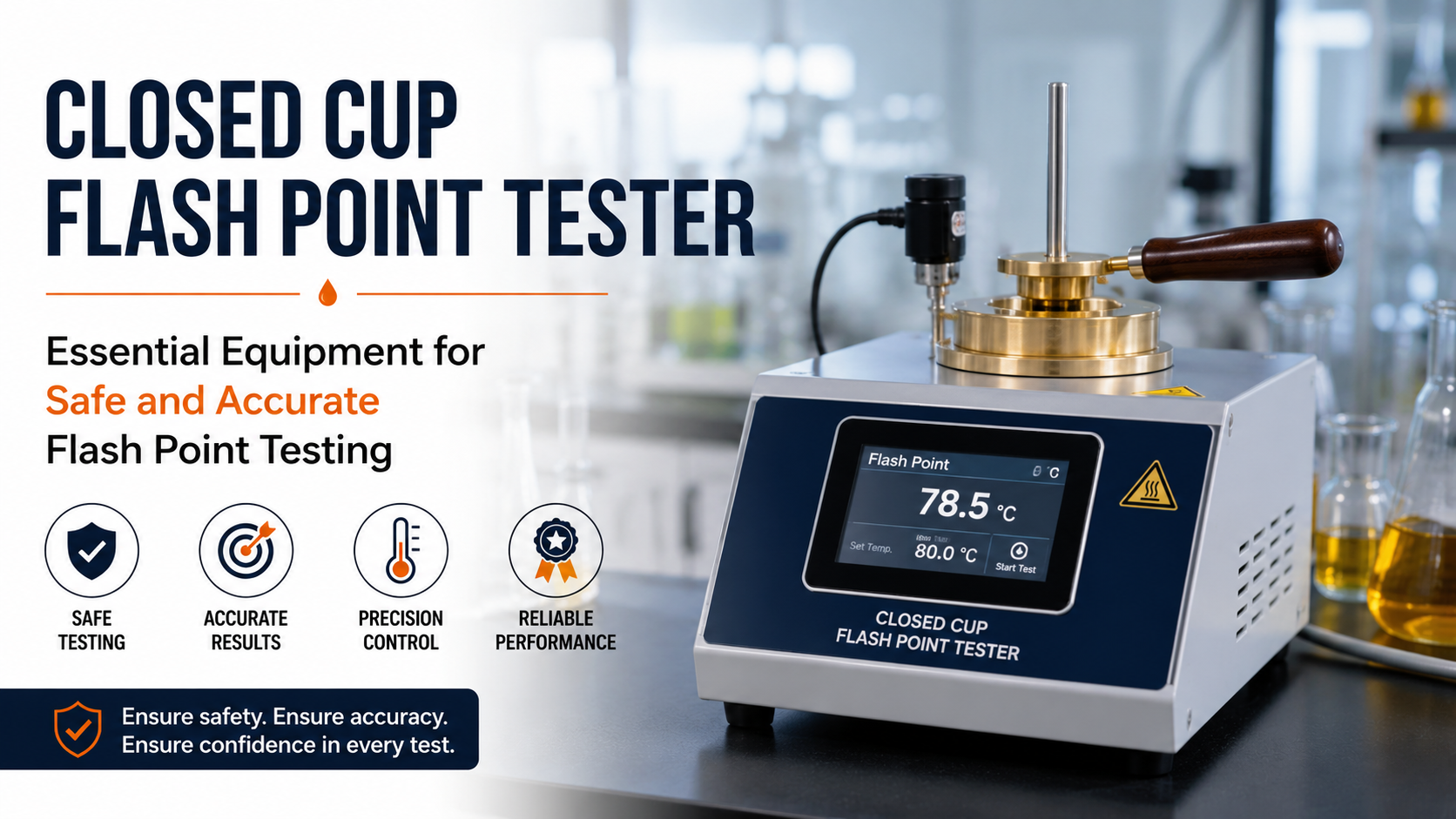
Accurate flash point determination is essential for laboratories that evaluate combustible and flammable liquids. A closed cup flash point tester is specifically designed to measure the lowest temperature at which a sample releases enough vapor to ignite under controlled conditions. Because the test takes place in a sealed environment, a closed cup flash point tester provides reliable and repeatable results while reducing the influence of external factors.
From petroleum laboratories to chemical research facilities, a closed cup flash point tester supports safety, regulatory compliance, and quality control by delivering dependable analytical data.
What Is a Closed Cup Flash Point Tester?
A closed cup flash point tester is a laboratory instrument used to determine the flash point of liquids by heating a sample inside a closed chamber. At specific temperature intervals, an ignition source is introduced to detect the presence of ignitable vapors.
Unlike open testing methods, a closed cup flash point tester minimizes vapor loss, making it suitable for measuring samples with relatively low flash points.
Why Flash Point Testing Is Important
Flash point testing helps laboratories evaluate the fire hazards associated with liquids during storage, transportation, and handling.
A closed cup flash point tester provides valuable information for:
- Product safety evaluation
- Quality assurance
- Research and development
- Regulatory compliance
- Hazard classification
Accurate flash point data contributes to safer laboratory and industrial operations.
Improved Testing Reliability
Because the sample remains enclosed throughout the test, a closed cup flash point tester reduces environmental interference and improves measurement consistency.
Applications of a Closed Cup Flash Point Tester
The versatility of a closed cup flash point tester makes it useful across numerous industries.
Petroleum Laboratories
Fuel, lubricating oil, and other petroleum products are commonly analyzed using a closed cup flash point tester to determine safe handling conditions.
Chemical Testing
Chemical manufacturers and research laboratories rely on a closed cup flash point tester to evaluate solvents and other combustible liquids.
Paint and Coating Analysis
Many paints, varnishes, and coatings require flash point testing before production and distribution.
Research Laboratories
Scientists use a closed cup flash point tester when developing and evaluating new liquid formulations.
Features to Consider
Choosing the right closed cup flash point tester depends on laboratory requirements and testing frequency.
Precise Temperature Control
Accurate heating systems help a closed cup flash point tester produce dependable and repeatable results.
Automatic Operation
Automation improves efficiency while reducing operator error.
Reliable Ignition System
A dependable ignition mechanism ensures consistent flash point detection.
User-Friendly Controls
Simple operation makes a closed cup flash point tester easier to use in busy laboratory environments.
Benefits of Using a Closed Cup Flash Point Tester
A closed cup flash point tester offers several important advantages.
Higher Measurement Accuracy
The enclosed testing chamber minimizes vapor loss and improves analytical precision.
Better Repeatability
Consistent testing conditions produce highly repeatable results.
Enhanced Laboratory Safety
The enclosed design reduces vapor exposure during testing.
Increased Productivity
Automated features allow laboratories to process more samples efficiently.
Best Practices for Accurate Testing
Following proper operating procedures helps maximize the performance of a closed cup flash point tester.
Prepare Samples Correctly
Ensure samples are clean and representative before testing.
Maintain Calibration
Routine calibration helps maintain the accuracy of a closed cup flash point tester.
Clean After Each Test
Removing residue prevents contamination between samples.
Follow Standard Testing Procedures
Consistent testing methods improve reliability and repeatability.
Maintenance Guidelines
Routine maintenance extends the service life of a closed cup flash point tester.
Recommended maintenance includes:
- Cleaning the testing chamber
- Inspecting ignition components
- Verifying temperature accuracy
- Checking seals and moving parts
- Performing scheduled calibration
Regular maintenance minimizes downtime while ensuring dependable laboratory performance.
Choosing the Right Closed Cup Flash Point Tester
Before selecting a closed cup flash point tester, laboratories should evaluate several factors.
Testing Volume
Higher workloads may require greater automation.
Accuracy Requirements
Select equipment that meets laboratory precision standards.
Ease of Maintenance
Simple maintenance supports uninterrupted laboratory operations.
Laboratory Applications
Consider the types of liquids routinely tested to ensure compatibility.
Conclusion
Reliable flash point testing plays an important role in laboratory safety and product evaluation. A closed cup flash point tester provides accurate, repeatable measurements by performing tests in a controlled, enclosed environment. Its precision, safety features, and wide range of applications make it an essential instrument for petroleum testing, chemical analysis, research, and quality control laboratories.
With proper operation and routine maintenance, a closed cup flash point tester delivers dependable analytical performance while supporting laboratory efficiency and compliance. Choosing a high-quality closed cup flash point tester ensures consistent testing results and long-term value for any laboratory.